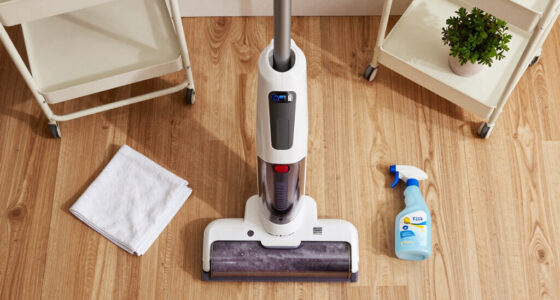
Robotic floor scrubbers have moved far beyond simple robot vacuums — today’s best models combine strong suction, powered mopping systems, self-maintenance docks, and smart mapping to genuinely replace the mop and bucket. My top pick is the Roborock Saros 10R, whose 22,000Pa suction and dedicated edge cleaning handle both daily dirt and corners most robots miss. For commercial spaces, the Dapper Supply Autonomous Scrubber & Carpet Vacuum with Auto Docking justifies its price with true walk-away operation across hard floors and carpet. If you’re on a tighter budget, the eufy E25 with its HydroJet roller mop delivers scrubbing performance closer to premium models than its cost suggests. The main tradeoff in this category is between upfront price and automation depth — self-emptying, self-washing docks save hours but add cost and bulk. Keep reading for the full breakdown of all 12 models.

Get cleaning gear delivered free — and shop member deals
- Fast, free delivery on millions of items
- Access to Prime Big Deal Days deals on October 6–7
- Prime Video, Amazon Music and more included
Complete the kit


Key Takeaways
- Suction specs ranged from roughly 3,000Pa to 22,000Pa across the lineup, but real scrubbing quality depended more on mop design — roller mops like the eufy E25’s HydroJet and dual-spin pads like the EVERYBOT outperformed flat pad systems on dried, stuck-on messes.
- Self-maintaining docks were the single biggest quality-of-life differentiator: models with self-emptying bases (Tikom with self-emptying dock, Roborock Saros 10R) saved the most weekly hands-on time despite costing more.
- Only two options in this roundup are built for commercial floor areas — the Commercial Carpet & Hard Floor Cleaning Robot and the Dapper Supply Autonomous Scrubber — and they exist in a different price and size class than every consumer model here.
- Budget models under $200, like the ILIFE V5s Plus and ROPVACNIC, can handle light daily mopping on hard floors but lack mapping, so they clean randomly and repeat — a real tradeoff for homes larger than about 1,000 square feet.
- Battery runtime clustered tightly around 150 minutes among mid-tier picks, which made smart mapping efficiency, not battery size, the deciding factor for whole-floor coverage in a single run.
| Commercial Carpet & Hard Floor Cleaning Robot |  | Best for Large Commercial Spaces | Cleaning Path Width: 13 inches | Tank Capacity: 0.8 gallons | Auto Drying: Yes | VIEW LATEST PRICE | See Our Full Breakdown |
| EVERYBOT Three-Spin Mopping Robot for Hard Floors |  | Best Value for Pure Scrubbing Power | Mop System: Three independently spinning pads | Water Tank: 0.3 liters | Noise Level: 43 dB | VIEW LATEST PRICE | See Our Full Breakdown |
| Dapper Supply Commercial Autonomous Robotic Floor Scrubber & Carpet Vacuum with Auto Docking Station |  | Best Premium Commercial Pick | Surfaces: Hard floors, carpet, tile, concrete, vinyl, epoxy | Docking: Automatic dock with water refill and drainage | Control: App, Remote | VIEW LATEST PRICE | See Our Full Breakdown |
| Tikom Robot Vacuum and Mop Combo, 5000Pa Suction, 150 Min Battery |  | Best Budget Hybrid for Homes | Suction: 5000Pa | Runtime: Up to 150 minutes | Dustbin: 450 ml | VIEW LATEST PRICE | See Our Full Breakdown |
| eufy E25 Robot Vacuum and Mop Combo, 20,000 Pa, HydroJet Roller Mop |  | Best Premium Home Pick | Suction: 20,000 Pa | Mop System: HydroJet roller, water refreshed 2x per second | Dust Capacity: 3L (auto-empty) | VIEW LATEST PRICE | See Our Full Breakdown |
| Tikom L8000 Pro Robot Vacuum and Mop Combo |  | Best for Multi-Floor Homes | Suction Power: 6000Pa | Battery Life: 150 minutes | Water Tank Capacity: 300ml | VIEW LATEST PRICE | See Our Full Breakdown |
| ILIFE V5s Plus Robot Vacuum and Mop Combo |  | Best Budget Pick | Surface Recommendation: Hard floor, tile, laminate, low-pile carpet | Battery Life: 110 minutes | Cleaning Path Width: 11.8 inches | VIEW LATEST PRICE | See Our Full Breakdown |
| Robotic Floor Scrubber (Commercial Modular Unit) |  | Best Modular Commercial Design | Cleaning System: Modular — swappable dry and wet cleaning heads | Functions: Sweeping, mopping, dusting, vacuuming | Auto Charging: Returns to charging base automatically | VIEW LATEST PRICE | See Our Full Breakdown |
| Tikom Robot Vacuum and Mop with Self-Emptying Base |  | Best for Low-Maintenance Cleaning | Suction Power: 6000Pa | Self-Emptying Base Capacity: 3L | Battery Life: 150 minutes | VIEW LATEST PRICE | See Our Full Breakdown |
| Floor Scrubber Robot (Commercial Autonomous Unit) |  | Best for Large Commercial Spaces | Cleaning Functions: 4-in-1: sweeping, vacuuming, wet mopping | Navigation: Autonomous with obstacle avoidance | Battery Life: 20 minutes (as listed) | VIEW LATEST PRICE | See Our Full Breakdown |
| Roborock Saros 10R Robot Vacuum and Mop with 22,000Pa Suction and Edge Cleaning |  | Best Premium Pick | Suction Power: 22,000 Pa | Height: 3.14 inches (ultra-slim) | Navigation: StarSight Autonomous System 2.0 | VIEW LATEST PRICE | See Our Full Breakdown |
| ROPVACNIC Robot Vacuum and Mop Combo 5200Pa Suction |  | Best for Pet Households | Suction Power: 5200Pa | Water Tank: High-capacity with four-stage adjustment | Cleaning Modes: Multiple, customizable | VIEW LATEST PRICE | See Our Full Breakdown |
| robotic floor scrubber | Battery Life |
|---|---|
| Commercial Carpet & Hard Floor | — |
| EVERYBOT Three-Spin Mopping Ro | — |
| Dapper Supply Commercial Auton | — |
| Tikom Robot Vacuum and Mop Com | — |
| eufy E25 Robot Vacuum and Mop | — |
| Tikom L8000 Pro Robot Vacuum a | 150 minutes |
| ILIFE V5s Plus Robot Vacuum an | 110 minutes |
| Robotic Floor Scrubber | Hours of continuous cleaning |
| Tikom Robot Vacuum and Mop wit | 150 minutes |
| Floor Scrubber Robot | 20 minutes (as listed) |
| Roborock Saros 10R Robot Vacuu | 2.5 hours |
| ROPVACNIC Robot Vacuum and Mop | — |
More Details on Our Top Picks
Commercial Carpet & Hard Floor Cleaning Robot
This model is the closest thing in the lineup to a true commercial workhorse, built for hotel lobbies, apartment hallways, and other high-traffic hard floors. Unlike the EVERYBOT Three-Spin, which is limited to residential rooms and a 0.3-liter tank, this machine carries a 0.8-gallon solution capacity and scrubs plus dries in a single pass — a real advantage when floors need to be walkable again quickly. App control, scheduled programming, and AI navigation put it a step above simpler remote-only rivals. The tradeoffs are real: it’s overkill for homes, the 13-inch cleaning path means big facilities need patience, and the feature set assumes some technical comfort compared with plug-and-play options like the Tikom G8000 Max.
Pros:- Scrubs and dries floors in one pass, so areas stay usable immediately after cleaning
- 0.8-gallon tank and auto water dispensing reduce refill interruptions on long runs
- Multiple control options including app scheduling and remote operation
- Obstacle avoidance and AI navigation cover open commercial layouts thoroughly
Cons:- 13-inch cleaning path makes very large facilities slow to cover
- Commercial-grade complexity demands setup time and technical familiarity
- Battery will eventually need replacement despite the 2-year rating
Best for: Facility managers at hotels, apartments, or offices who need scheduled autonomous scrubbing across large hard-floor areas
Not ideal for: Homeowners — the size, capacity, and commercial feature set are wasted money in a house or small apartment
- Cleaning Path Width:13 inches
- Tank Capacity:0.8 gallons
- Auto Drying:Yes
- Control Methods:App, Remote, Push Button, Scheduled Programming
- Surfaces:Tile, Marble, Hardwood, Laminate, Vinyl
- Battery:25.6V lithium
- Filters:Foam, HEPA, Pre-filter
Our verdict“Buy this if you manage a commercial space that needs unattended, scheduled scrubbing; skip it for anything residential.”
EVERYBOT Three-Spin Mopping Robot for Hard Floors
For shoppers who care about scrubbing performance per dollar, the EVERYBOT Three-Spin punches well above its price. Its three independently spinning pads genuinely attack dried-on stains in a way single-pad moppers like the Tikom G8000 Max can’t match, and its 43dB operation makes it one of the quietest machines here — quiet enough for overnight runs. What you give up is everything smart: there’s no app, no Wi-Fi, no mapping, so navigation is basic bump-and-turn rather than the planned routes you get from the eufy E25. The 0.3-liter tank also means mid-run refills on larger homes. Compared with the Commercial Carpet & Hard Floor robot, this is clearly a home machine — but for tile and hardwood households on a budget, it’s the strongest dedicated scrubber at this price.
Pros:- Three spinning pads remove stubborn, dried-on stains better than single-pad moppers
- Extremely quiet at 43dB — suitable for cleaning while people sleep or work
- Up to 120 minutes of runtime covers most homes on one charge
- Award-winning, low-profile design fits under furniture easily
Cons:- No app or Wi-Fi connectivity — remote control only
- 0.3-liter water tank needs frequent refilling in larger spaces
- Hard floors only; completely useless on carpet
Best for: Budget-conscious homeowners with hard floors who want aggressive stain scrubbing without paying for smart features
Not ideal for: Carpeted homes or anyone who wants app control and mapping — this has neither
- Mop System:Three independently spinning pads
- Water Tank:0.3 liters
- Noise Level:43 dB
- Runtime:Up to 120 minutes
- Control:Remote control
- Surfaces:Hard floors, tile
- Power Levels:7
Our verdict“The best cheap dedicated floor scrubber for hard-floor homes, as long as you can live without smart features.”
Dapper Supply Commercial Autonomous Robotic Floor Scrubber & Carpet Vacuum with Auto Docking Station
This is the most complete commercial system in the roundup, and its 10-year warranty immediately signals a different tier of commitment than anything else here. Where the Commercial Carpet & Hard Floor robot handles scrubbing alone, Dapper Supply adds carpet vacuuming, automatic docking, and self water refill and drainage — meaning the machine genuinely runs itself for extended periods in warehouses, schools, or retail stores. The auto-docking station is the key differentiator against every residential option like the eufy E25: this is built for facilities where nobody babysits the robot. The obvious cost is price — commercial-grade autonomy isn’t cheap — and it’s indoor only, so loading docks and exterior walkways stay on the to-do list.
Pros:- Vacuums carpet and scrubs hard floors in one autonomous system
- Auto docking with water refill and drainage enables genuinely unattended operation
- Smart route planning and obstacle detection handle complex commercial layouts
- 10-year warranty with U.S.-based support is exceptional for this category
Cons:- High upfront investment compared with every other pick here
- Requires dedicated space and power for the docking station
- Indoor use only
Best for: Schools, hospitals, warehouses, and retail operators who need true hands-off daily cleaning across mixed hard floor and carpet surfaces
Not ideal for: Small businesses or homeowners — the cost and docking infrastructure far exceed what residential-scale cleaning requires
- Surfaces:Hard floors, carpet, tile, concrete, vinyl, epoxy
- Docking:Automatic dock with water refill and drainage
- Control:App, Remote
- Filter:HEPA
- Navigation:Automatic route planning with obstacle detection
- Warranty:10-year manufacturer warranty
- Environments:Warehouses, retail, schools, hospitals, airports, offices
Our verdict“The most future-proof choice for large facilities that want a set-it-and-forget-it cleaning crew, if the budget allows.”
Tikom Robot Vacuum and Mop Combo, 5000Pa Suction, 150 Min Battery
The Tikom G8000 Max is the sensible middle ground for buyers who want vacuuming and mopping in one affordable package without the premium price of the eufy E25. Its 5000Pa suction handles pet hair and everyday debris on hard floors and carpet, and the 150-minute runtime actually beats the eufy’s 125 minutes. At just under 3 inches tall, it slides under couches where taller robots can’t. That said, it’s a mop — not a scrubber. If your priority is attacking dried, ground-in stains, the EVERYBOT Three-Spin’s spinning pads do a more aggressive job. App, voice, and remote control give it far more flexibility than the EVERYBOT, though, making this the better all-rounder for mixed-floor homes on a budget.
Pros:- Vacuums and mops simultaneously across hard floors and carpet
- 5000Pa suction handles pet hair and fine debris effectively
- 150-minute runtime covers large homes in a single run
- Slim 2.99-inch profile reaches under most furniture
Cons:- Flat mop pad provides light mopping, not deep scrubbing
- No self-emptying or mop-washing base at this price
- App compatibility details are thinner than pricier competitors
Best for: Pet owners and families with mixed hard floors and low-pile carpet who want one affordable robot to vacuum and mop
Not ideal for: Buyers with heavy dried-on stains or grout lines — the flat mop pad scrubs far less aggressively than spinning-pad rivals
- Suction:5000Pa
- Runtime:Up to 150 minutes
- Dustbin:450 ml
- Water Tank:300 ml
- Height:2.99 inches
- Noise Level:45 dB
- Control:App, Remote, Voice, Button
- Surfaces:Hard floor, carpet
Our verdict“The best value hybrid for everyday vacuum-plus-mop upkeep, as long as you don’t expect true scrubbing power.”
eufy E25 Robot Vacuum and Mop Combo, 20,000 Pa, HydroJet Roller Mop
For homeowners who want the most hands-free residential experience money can buy, the eufy E25 is the standout. Its HydroJet roller mop refreshes water twice per second, which solves the dirty-mop-streaks problem that plagues pad-based rivals like the Tikom G8000 Max — you’re always mopping with clean water. Add 20,000Pa suction, auto-empty into a 3-liter dust bag, and self-washing mops, and the day-to-day maintenance drops to almost nothing. Multi-floor mapping for up to five levels makes it the natural pick for large or multi-story homes. It can’t touch the commercial autonomy of the Dapper Supply system, and setup takes real effort up front, plus the 2.4GHz-only Wi-Fi limitation will annoy some router configurations.
Pros:- HydroJet roller constantly rinses with fresh water, avoiding dirty-mop streaks
- 20,000Pa suction is among the strongest available for pet hair and debris
- Auto-empty 3L dustbin and self-washing mops minimize hands-on upkeep
- Maps up to five floor plans for large or multi-story homes
Cons:- No 5GHz Wi-Fi support, which complicates some modern network setups
- Initial mapping and setup take noticeably longer than simpler robots
- Premium price far exceeds budget hybrids like the Tikom G8000 Max
Best for: Owners of large or multi-story homes, especially with pets, who want deep cleaning with near-zero daily maintenance
Not ideal for: Small apartments or tight budgets — you’re paying a premium for capacity and automation a studio dweller will never use
- Suction:20,000 Pa
- Mop System:HydroJet roller, water refreshed 2x per second
- Dust Capacity:3L (auto-empty)
- Runtime:125 minutes
- Connectivity:Wi-Fi, Alexa, Google Assistant, Siri
- Noise Level:≤61 dB
- Floor Plans:Up to 5 mapped levels
Our verdict“The best fully automated cleaning experience for large homes, provided your budget and Wi-Fi setup cooperate.”
Tikom L8000 Pro Robot Vacuum and Mop Combo
Where the standard Tikom 5000Pa combo treats mapping as a convenience, the Tikom L8000 Pro makes it the headline. With LiDAR navigation and storage for five separate floor maps, this model is built for split-level homes or anyone who moves a robot between properties. The 6000Pa suction puts it in the same performance bracket as the self-emptying Tikom below, but at a lower price since you give up the auto-empty base. Its 45dB quiet operation is a real advantage over louder high-suction rivals — you can run it during dinner without noticing. The tradeoff is maintenance: a 450ml dustbin fills fast in pet-heavy homes, and the 300ml water tank limits mopping to a few rooms before a refill. Setup also demands more patience than simpler units like the ILIFE V5s Plus.
Pros:- 6000Pa suction handles pet hair and embedded dust on carpet
- Five stored maps suit multi-floor or multi-home use
- Runs at just 45dB — quiet enough for daytime cleaning
- 150-minute runtime covers large homes on one charge
Cons:- 300ml water tank needs frequent refills for mopping large areas
- No self-emptying base means regular manual bin duty
- Setup and mapping process has a learning curve
Best for: Owners of multi-story homes with pets who want strong suction and quiet, scheduled cleaning across several floor plans
Not ideal for: Buyers who want zero maintenance — without a self-emptying base you’ll empty the bin every couple of days
- Suction Power:6000Pa
- Battery Life:150 minutes
- Water Tank Capacity:300ml
- Dustbin Capacity:450ml
- Noise Level:45dB
- Mapping:LiDAR smart navigation, 5 maps storage
- Connectivity:Wi-Fi 2.4GHz & 5GHz
- Voice Assistant Compatibility:Alexa & Google Home
Our verdict“This pick makes the most sense for multi-floor households that prioritize mapping flexibility and quiet operation over hands-free maintenance.”
ILIFE V5s Plus Robot Vacuum and Mop Combo
The ILIFE V5s Plus is the entry point of this lineup, and it earns that spot honestly. Compared with the Tikom L8000 Pro, it lacks LiDAR mapping and stops at 110 minutes of runtime — but it covers the fundamentals: five cleaning modes, app and voice control, and both vacuum and mop functions at a fraction of the price. Its 11.8-inch cleaning path is wide for a budget unit, so open floor plans get covered faster than you’d expect. The catch is that the dustbin and water tank are separate modules, so you cannot vacuum and mop in one pass the way the Tikom self-emptying model can. The app also works on 2.4GHz networks only, which will frustrate households running dual-band routers.
Pros:- Genuine vacuum-plus-mop versatility at a budget price
- Three control options: app, remote, and voice
- Wide 11.8-inch cleaning path speeds up open rooms
- Handles hard floors, tile, laminate, and low-pile carpet
Cons:- Cannot vacuum and mop simultaneously — modules must be swapped
- 2.4GHz-only app support limits router compatibility
- Around 5 hours to fully charge before first use
Best for: First-time robot owners and renters with mostly hard floors who want app control without a big spend
Not ideal for: Tech-savvy users on 5GHz networks or anyone expecting simultaneous vacuum-mop cleaning
- Surface Recommendation:Hard floor, tile, laminate, low-pile carpet
- Battery Life:110 minutes
- Cleaning Path Width:11.8 inches
- Cleaning Modes:5 high-efficiency modes
- Control Methods:App, remote, voice (Alexa & Google)
- Tank Capacity:300ml
- Power Source:Rechargeable lithium-ion battery
Our verdict“A sensible low-cost entry for small hard-floor homes where swapping tanks between vacuum and mop runs isn’t a dealbreaker.”
Robotic Floor Scrubber (Commercial Modular Unit)
Unlike the consumer combo units from Tikom and ILIFE, this is a true commercial robotic floor scrubber built for facilities rather than living rooms. Its standout feature is modular cleaning heads that swap between dry and wet tasks, letting one machine sweep a warehouse aisle in the morning and scrub it after lunch. The compact, rugged chassis slips into narrow spaces that bulkier commercial units — like the Dapper Supply scrubber elsewhere in this roundup — cannot reach. Auto-charging keeps it running across long shifts without an operator. The honest drawback is buying friction: pricing and full specifications require contacting the manufacturer, so you can’t comparison shop the way you can with the off-the-shelf models here. Expect a consultation, not a one-click purchase.
Pros:- Swappable dry and wet modules cover sweeping, mopping, dusting, and vacuuming
- Auto-return charging supports long unattended runs
- Compact footprint handles narrow commercial corridors
- Rugged construction built for daily facility use
Cons:- No transparent pricing — requires manufacturer contact for quotes and specs
- Setup and deployment likely needs staff training
Best for: Facilities managers at retail stores, clinics, or small warehouses who need adaptable dry/wet cleaning in tight layouts
Not ideal for: Homeowners or small-office buyers — this is commercial equipment with procurement complexity to match
- Cleaning System:Modular — swappable dry and wet cleaning heads
- Functions:Sweeping, mopping, dusting, vacuuming
- Auto Charging:Returns to charging base automatically
- Battery Life:Hours of continuous cleaning
- Design:Compact, rugged, space-saving
- Pricing:Custom quote via manufacturer
Our verdict“This model is better suited to businesses that need one adaptable machine for mixed dry and wet floor care than to anyone shopping retail.”
Tikom Robot Vacuum and Mop with Self-Emptying Base
This is the L8000 Pro with the chore removed. The core robot carries the same 6000Pa suction and 150-minute runtime, but the 3L self-emptying base holds weeks of debris — the single biggest quality-of-life upgrade in robot cleaning. Compared with the L8000 Pro, you’re paying more to stop thinking about the dustbin entirely, which matters most in pet households. Unlike the ILIFE V5s Plus, it vacuums and mops simultaneously with 360° LiDAR navigation across up to five floor plans. The tradeoff is mop management: carpet areas require removing the mop holder or configuring no-go zones, or you risk damp rugs. The feature set is also dense — first-time owners may spend an evening in the app before everything runs smoothly.
Pros:- 3L self-emptying base holds weeks of debris between empties
- Simultaneous vacuum-and-mop cleaning saves time
- 360° LiDAR with multi-floor mapping for up to 5 levels
- 6000Pa suction matches the L8000 Pro for pet hair
Cons:- Mop must be removed or zoned off before carpet runs
- Dense feature set presents a learning curve for new users
- Commands a premium over the non-self-emptying L8000 Pro
Best for: Pet owners and busy households who want to vacuum and mop in one pass and empty a bin every few weeks, not days
Not ideal for: Carpet-heavy homes — the mop-on-board design demands constant no-go zone management
- Suction Power:6000Pa
- Self-Emptying Base Capacity:3L
- Battery Life:150 minutes
- Navigation:360° LiDAR with obstacle avoidance
- Floors Supported:Up to 5 floor maps
- Cleaning Modes:Simultaneous vacuum and mop
- Connectivity:Wi-Fi 2.4GHz & 5GHz
Our verdict“The pick for buyers whose top priority is never thinking about their robot between cleanings — provided carpets are a small share of the floor plan.”
Floor Scrubber Robot (Commercial Autonomous Unit)
Positioned above the modular commercial scrubber, this unit targets large open environments — hotel lobbies, long corridors, retail floors. Its advantages over the smaller B0HFM1MC84 are large-capacity tanks that cut refilling stops during long shifts and a full 4-in-1 cleaning suite with autonomous navigation and obstacle avoidance, so it works around foot traffic without an escort. Auto-recharge keeps operation continuous across cleaning cycles. But the listing data raises a flag I can’t ignore: a stated 20-minute battery life is thin for the very large spaces this robot is marketed toward, and buyers should verify real-world runtime with the seller before committing. Like its modular sibling, pricing is opaque, which makes it hard to stack against retail options like the eufy E25 on pure value.
Pros:- Smart navigation with obstacle avoidance works around pedestrians
- 4-in-1 sweeping, vacuuming, and wet mopping functions
- Large tanks reduce refill interruptions on long shifts
- Auto-recharge supports continuous scheduled operation
Cons:- Listed 20-minute battery life may not suit the large spaces it targets
- Variable, quote-based pricing makes comparison shopping difficult
- Detailed specifications are sparse in the listing
Best for: Hotel and facility operators covering wide corridors and lobbies who need autonomous navigation around guests and obstacles
Not ideal for: Small businesses without the budget clarity or floor area to justify commercial procurement
- Cleaning Functions:4-in-1: sweeping, vacuuming, wet mopping
- Navigation:Autonomous with obstacle avoidance
- Battery Life:20 minutes (as listed)
- Tanks:Large-capacity water tanks
- Recharging:Auto-recharge
- Controller:Remote control
- Dimensions:8″L x 11″W x 16″H
Our verdict“A capable autonomous option for wide commercial floors — but verify battery runtime and pricing with the seller before signing off.”
Roborock Saros 10R Robot Vacuum and Mop with 22,000Pa Suction and Edge Cleaning
The Roborock Saros 10R is the most technically ambitious machine in this lineup, and its 3.14-inch profile is the feature that justifies the price tag on its own. While the eufy E25 matches it on raw suction at 20,000 Pa, neither the eufy nor the Tikom L8000 Pro can slide under the low sofas, beds, and console tables where dust actually accumulates. The StarSight navigation system recognizes 108 obstacle types, which translates to fewer rescue missions under chair legs compared with budget picks like the ROPVACNIC S1. Its dock is the real differentiator: it detaches and washes the mop pads in hot water, dries them, and holds dust for 60 days, so maintenance becomes a monthly task rather than a weekly chore.
The tradeoffs are real, though. Setup is more involved than simpler models, and 2.4GHz-only Wi-Fi can be a headache on modern mesh networks.
Pros:- Ultra-slim 3.14-inch body reaches under furniture no competitor in this lineup can access
- 22,000 Pa suction outcleans everything here except the eufy E25
- Full self-maintaining dock: hot-water mop washing, drying, and 60-day dust collection
- StarSight navigation with 108 obstacle types means far fewer stuck-robot incidents
Cons:- 2.4GHz-only Wi-Fi limits compatibility with modern mesh router setups
- Steep learning curve — the app and mapping features overwhelm first-time robot vacuum owners
Best for: Homeowners with lots of low-clearance furniture who want a genuinely hands-free vacuum-plus-mop system with minimal ongoing maintenance
Not ideal for: Buyners on tight budgets or anyone with a 5GHz-only network — the premium features go to waste if connectivity or complexity frustrates you
- Suction Power:22,000 Pa
- Height:3.14 inches (ultra-slim)
- Navigation:StarSight Autonomous System 2.0
- Obstacle Detection:108 obstacle types
- Battery Life:2.5 hours
- Dock Features:Auto mop removal, hot water wash, drying, 60-day dust collection
- Connectivity:Wi-Fi 2.4GHz, Hello Rocky voice assistant
Our verdict“If under-furniture cleaning and true hands-free maintenance matter more than saving money, this is the machine to buy.”
ROPVACNIC Robot Vacuum and Mop Combo 5200Pa Suction
The ROPVACNIC S1 earns its spot by solving one specific problem better than most: pet hair. Its no-entanglement design with dual electric side brushes keeps fur from wrapping around the roller, a chronic failure point on cheaper combo units like the ILIFE V5s Plus. At 5200 Pa, suction sits comfortably above the Tikom 5000Pa model while costing less overall than the flagship-tier Roborock Saros 10R — though the gap in navigation and dock automation is obvious. What this model offers instead is practicality: a four-stage adjustable water tank lets you dial mopping from light dusting to heavier spills, and app, Alexa, and Google Assistant control cover the smart-home basics without overwhelm.
Just don’t expect marathon sessions; the battery limits large-area cleaning, so multi-story homes will need multiple runs.
Pros:- No-entanglement dual side brushes handle pet hair without roller tangles
- 5200Pa suction beats similarly priced 5000Pa rivals like the Tikom
- Four-stage water tank adjustment gives real control over mop wetness
- Full smart control via app, Alexa, and Google Assistant
Cons:- Battery life limits coverage on larger floor plans
- No self-cleaning dock — you’ll rinse pads and empty bins by hand, unlike the Roborock Saros 10R
- Setup and mode configuration involve a learning curve for beginners
Best for: Pet owners in apartments or single-floor homes who want capable hair pickup plus adjustable mopping without flagship pricing
Not ideal for: Owners of large or multi-story homes — the battery runs out mid-job, and there’s no self-emptying dock to extend autonomy
- Suction Power:5200Pa
- Water Tank:High-capacity with four-stage adjustment
- Cleaning Modes:Multiple, customizable
- Pet Hair Handling:No-entanglement design with dual electric side brushes
- Connectivity:Smartphone app, Alexa, Google Assistant
- Design:Compact, fits hard-to-reach areas
Our verdict“A sensible mid-range choice for fur-covered floors in smaller homes, as long as you accept manual maintenance.”
How We Picked
I evaluated these 12 robotic floor scrubbers against the criteria that actually change the ownership experience: scrubbing performance (mop mechanism, downward pressure, and ability to lift dirt rather than smear it), suction power for pre-cleaning debris before mopping, navigation intelligence (mapped, systematic routes versus random bouncing), and automation depth — whether the dock empties dust, washes mops, or just charges. I also weighed runtime against coverage needs, since 150 minutes only matters if the robot navigates efficiently enough to use it.
The ranking order reflects a simple logic: models that reduce the most human effort per week rank highest, provided floor-cleaning results justify the price. That’s why fully self-maintaining robots sit at the top, capable mid-tier mappers fill the middle, and budget random-navigation models land lower — not because they’re bad, but because they demand more babysitting. Commercial units were judged on a separate scale entirely, prioritizing durability, floor-type versatility, and unattended runtime over app features.
Factors to Consider When Choosing Robotic Floor Scrubbers
Before settling on a specific model, it helps to understand the broader patterns in this category — where the money goes, which specs are marketing noise, and which mistakes buyers repeatedly make.Mop Mechanism Matters More Than Suction Numbers
The most common mistake I see is shopping for robotic floor scrubbers by suction specs alone. Suction determines how well the machine vacuums before mopping, but scrubbing quality comes from the mop system itself: roller mops with active water jets, dual spinning pads, and vibrating flat pads perform very differently on dried spills and sticky residue. If your priority is genuinely scrubbed floors — kitchen grime, bathroom residue, entryway salt — a strong mop mechanism beats an extra 5,000Pa of suction every time. Pad-based systems also wear out and need replacements, which adds a recurring cost that roller systems often avoid. Buyers who ignore this end up with a great robot vacuum that merely drags a damp cloth around. Match the mop type to your worst-case mess, not your average day.
Home Size Should Dictate Navigation Class
Navigation is the quiet dividing line in this category. Mapped navigation — LiDAR or camera-based systems that clean in systematic rows — matters far more in larger homes, because random-navigation robots waste battery re-cleaning the same paths and can leave patches untouched. In a small apartment under 800 square feet, the difference is minor since even a random robot covers everything eventually. Past roughly 1,200 square feet, systematic mapping isn’t a luxury; it’s the difference between one cleaning pass and two. Mapping also unlocks zone control, no-go areas, and room-specific mopping, which random robots simply cannot offer. My advice: don’t pay for premium mapping in a studio, and don’t cheap out on it in a two-story house.
What the Base Station Actually Does for You
Not all docks are equal, and the marketing rarely makes the distinction clear. A self-charging dock is standard on nearly everything here and adds little value on its own. A self-emptying base pulls debris from the robot into a bag every cycle, extending hands-off time from one day to several weeks. The most advanced stations also wash and dry the mop pads, which prevents the mildew smell that plagues cheaper wet-clean robots and eliminates the grossest manual chore in robot ownership. Each tier adds roughly $100–300 to the price and considerable counter bulk, so measure your space. If you mop only weekly, a basic dock plus manual pad rinsing is perfectly reasonable. If the robot runs daily, the full self-maintaining base pays for itself in avoided chores.
Consumer Robots Versus Commercial Machines
This roundup spans two fundamentally different product classes, and confusing them leads to expensive mistakes. Consumer robots excel at maintaining already-reasonable floors daily in homes, with app controls and quiet operation. Commercial robotic scrubbers — like the Dapper Supply and Commercial Carpet & Hard Floor units — are built for warehouses, retail floors, and office spaces, with larger tanks, heavy-duty brush systems, and durability ratings measured in operating hours. A consumer robot will not survive commercial duty cycles, and a commercial machine is oversized, loud, and awkward for home use despite its cleaning power. The honest question is square footage and soil level: heavy foot traffic, 2,000+ square feet of hard commercial flooring, or mixed carpet and tile at scale all point commercial. Anything less, and the consumer tier handles it.
The Hidden Costs After Purchase
Robotic floor scrubbers carry ongoing costs the sticker price hides. Consumables include replacement mop pads, brushes, filters, and self-emptying dust bags, which can run $50–150 per year depending on model and usage. Robots that use proprietary cleaning solution — rather than accepting plain water or any detergent — lock you into a subscription-like purchasing pattern. Filter and brush replacement schedules also vary widely; a model requiring pad changes monthly costs meaningfully more over three years than one with washable roller components. Before buying, check consumable prices and availability, because a discounted robot with expensive proprietary supplies often costs more long-term than a full-price model with cheap generic parts. The cheapest robot to buy is rarely the cheapest to own.
Floor Type Compatibility Is Not Guaranteed
Buyers frequently assume any robot that mops handles any floor, but compatibility varies sharply. Most consumer scrubbers are designed for sealed hard floors — tile, laminate, vinyl, sealed hardwood — and can damage unsealed wood or warp susceptible planks with repeated wet cleaning. Carpet is a different question entirely: some combos lift or retract the mop automatically, while cheaper units drag a damp pad onto carpet unless you physically remove it, which is a daily annoyance. Homes with high carpet-to-hard-floor ratios should prioritize mop-lifting or dual-tank designs. Check the water tank capacity too, since small tanks mean refilling mid-session on larger floor plans. Matching the machine to your actual floor mix prevents the most common post-purchase regret in this category.
Frequently Asked Questions
Can a robot vacuum and mop combo really replace a traditional scrubber?
For regular maintenance cleaning on sealed hard floors, yes — modern combos with roller mops or spinning pads handle everyday grime, footprints, and light spills well enough that most owners stop manual mopping weekly. Where they fall short is deep scrubbing: ground-in grout dirt, old adhesive residue, or post-renovation dust still benefit from a periodic manual or commercial scrub. The models with powered scrubbing action, like the eufy E25’s HydroJet roller, close much of that gap compared to flat-pad robots. A realistic expectation is that the robot keeps floors 90% clean continuously, and you deep-clean once every month or two. Owners who expect a single pass to restore neglected floors will be disappointed by any consumer model.
Is a self-emptying base worth the extra cost?
It depends on how often the robot runs and how much debris your floors collect. If you have pets, kids, or daily foot traffic, a self-emptying base means the difference between touching the robot weekly versus monthly, which most owners describe as the feature they’d never give up. For a low-traffic home where the robot runs twice a week on mostly clean floors, the standard dustbin needs emptying anyway before it fills, and the base adds cost, bulk, and bag expenses without much benefit. One caveat: self-emptying bases are loud for the few seconds they run, usually at night-cycle volumes that can startle. If you run the robot while away from home, that drawback disappears entirely. Treat it as a convenience purchase, not a performance upgrade — cleaning results are identical.
How much suction power do I actually need for mopping?
Less than the spec race suggests. Suction matters for picking up loose debris before the mop passes — grit, crumbs, pet hair — and roughly 4,000–6,000Pa handles that adequately for most homes. Beyond that range, additional suction mostly helps on carpet, where the vacuum has to pull debris from pile fibers, so households with lots of carpet should aim higher, like the 20,000–22,000Pa tier of the eufy E25 or Roborock Saros 10R. For hard-floor-only homes, paying a premium for maximum suction buys little visible improvement in mopping results. What matters more is whether the robot picks up debris before mopping rather than smearing it, which is a design issue, not a suction number. Prioritize suction only if carpet is part of your cleaning mix.
Do robot mops damage hardwood floors?
Sealed hardwood is generally safe, but the risk comes from two sources: excess water and unsealed or worn finish. Robots that control water output precisely and use light mop pressure are safe on well-sealed floors; models that saturate pads or drag dripping mops pose more risk, especially on older finishes where sealant has worn thin in traffic paths. The practical safeguards are choosing a model with adjustable water flow, using the lowest setting on wood, and testing in an inconspicuous area for the first few weeks. Engineered hardwood and laminate are more water-sensitive than solid sealed hardwood, so keep flow minimal there. If your floors are unsealed, waxed, or visibly worn, stick to vacuum-only mode and manual damp-mopping until you refinish.
Should I buy a consumer robot or a commercial robotic scrubber for a small business?
The cutoff is roughly daily floor area and soil load. If you’re maintaining 1,500–3,000 square feet of hard flooring in a small office or boutique with light traffic, a high-end consumer model — the Roborock Saros 10R or eufy E25 — will handle it at a fraction of the cost and size of commercial units. Past that scale, or with heavy soil like warehouse dust, retail entrance grime, or food-service residue, consumer robots lack the tank capacity, brush pressure, and duty-cycle durability to keep up, and you’ll be refilling tanks constantly while the machine wears out early. Commercial units like the Dapper Supply autonomous scrubber are built to run hours daily for years, with auto-docking that makes unattended operation realistic. A useful rule: if you’d currently pay a cleaning service to scrub those floors, commercial-tier automation usually justifies its price.
Conclusion
The right robotic floor scrubber depends less on specs and more on what you’re asking it to do. Best overall goes to the Roborock Saros 10R, which pairs 22,000Pa suction, edge-cleaning coverage, and full self-maintenance in one package — the least compromise per dollar for most homes. Best premium for light-commercial and large residential spaces is the Dapper Supply Autonomous Scrubber with its auto-docking station, while the Commercial Carpet & Hard Floor Cleaning Robot suits buyers who need serious coverage across mixed flooring. Best value belongs to the eufy E25, whose HydroJet roller mop delivers near-flagship scrubbing well below flagship pricing. Best for beginners is the ILIFE V5s Plus — simple, affordable, and a low-risk way to learn whether robot mopping fits your routine before spending more. For specific needs: the Tikom L8000 Pro fits smart-home-heavy households with its mapping and voice assistant support, the EVERYBOT Three-Spin is the pick for hard-floor-only apartments where scrubbing matters more than vacuuming, and the Tikom with self-emptying base serves pet owners who want maximum hands-off time on a mid-tier budget. Whatever you choose, match the automation level to how often you’ll actually run it — that’s the decision that determines satisfaction more than any spec sheet.
Fall Picks
fall essentials
As an affiliate, we earn on qualifying purchases.