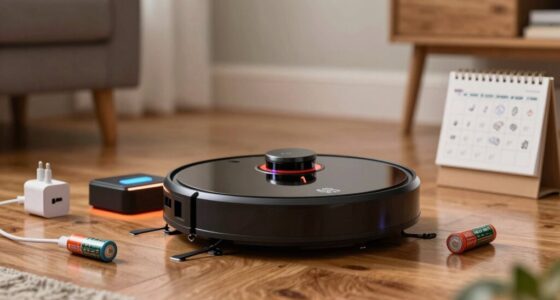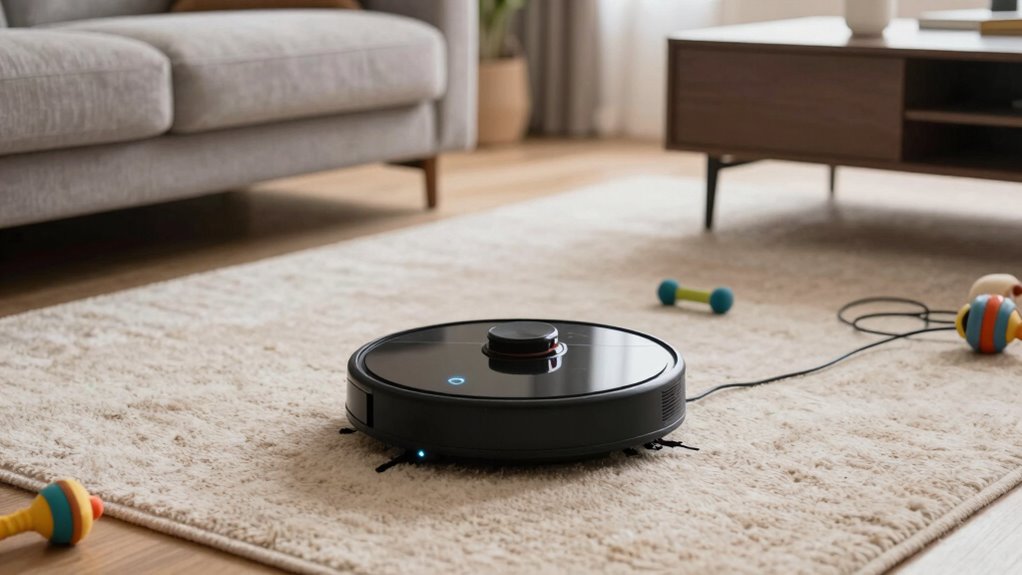

Many believe robot vacuums can see and avoid every obstacle perfectly, but that’s a myth. These devices rely on sensors like infrared and ultrasonic detectors, which have limits. They can spot simple obstacles like furniture and walls but often miss small objects, cords, or transparent items. Environmental factors like clutter or reflections can also confuse their sensors. To discover the real capabilities and limitations of these smart cleaners, keep exploring how they actually navigate your home.
Key Takeaways
- Robot vacuums rely on sensors that detect simple obstacles but often miss complex or transparent objects.
- Visual sensors have limitations in depth perception, lighting, shadows, and reflections, affecting obstacle detection accuracy.
- Sensor interference from reflective surfaces or dark floors can cause missed obstacles or false detections.
- Advanced mapping and obstacle avoidance are not foolproof; inaccuracies can lead to navigation errors.
- Regular calibration, decluttering, and updated software improve a vacuum’s ability to avoid obstacles effectively.
The Sensors Behind the Scenes
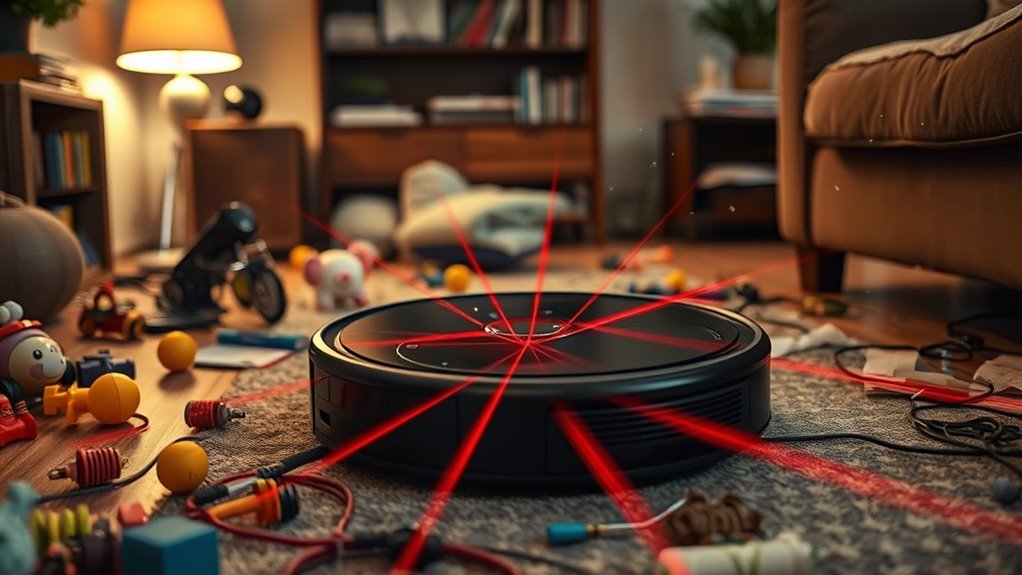
The sensors that enable robot vacuums to navigate are more advanced than many people realize. They rely on high sensor accuracy to map your space and detect obstacles. These sensors can interpret various surfaces and objects, but their effectiveness depends on obstacle complexity. Simple obstacles like walls and furniture are easily identified, allowing smooth navigation. However, when encountering more complex obstacles such as cords, small objects, or clutter, the sensors may struggle to detect them reliably. This is because sensor technology has limits, especially with irregular shapes or transparent items. While the sensors are impressive, understanding their constraints helps set realistic expectations about what your robot vacuum can truly perceive and avoid. Additionally, sensor limitations can affect performance, particularly in environments with unpredictable clutter or unusual objects. Recognizing these sensor constraints can help you optimize your cleaning routines and environment for better results. Being aware of these technology boundaries allows users to better troubleshoot navigation issues and improve overall effectiveness.
How Robot Vacuums Detect Obstacles

Robot vacuums rely on a combination of sensors to detect obstacles and navigate your space effectively. They use obstacle sensors that physically detect objects in their path, helping prevent collisions. Additionally, many models incorporate mapping technology, which creates a virtual layout of your home. This mapping allows the vacuum to understand where it’s cleaned and where it needs to go. Obstacle sensors can include infrared or ultrasonic sensors that sense nearby objects, while mapping technology builds a detailed map based on sensor data. Together, these systems enable your robot to avoid furniture, walls, and other obstacles. However, their effectiveness depends on sensor placement and quality. While they provide decent obstacle detection, they’re not perfect, and some smaller or transparent objects may still be missed. Proper sensor placement can significantly improve obstacle detection accuracy, especially when considering the sensor calibration to ensure optimal functioning.
Limitations of Visual Recognition

Although visual recognition technology has advanced considerably, it still faces notable limitations in obstacle detection for robot vacuums. One key issue is poor depth perception, which can cause the vacuum to misjudge distances or fail to recognize objects accurately. This sometimes results in false positives, where the system identifies an obstacle that isn’t there, leading to unnecessary avoidance maneuvers. Additionally, visual sensors struggle with varying lighting conditions, shadows, and reflections that distort perception. Moreover, the sensor technology used in many robot vacuums is still developing, which can limit their ability to adapt to complex environments effectively.
Common Misconceptions About Navigation

Many people believe that robot vacuums rely solely on advanced sensors or mapping technology to navigate efficiently, but this isn’t entirely true. In reality, mapping inaccuracies can occur due to imperfect sensor data, leading to missed spots or repeated paths. Sensor interference from reflective surfaces, dark floors, or clutter can also disrupt navigation, causing the vacuum to misjudge distances or get stuck. These misconceptions assume perfect technology, but in practice, your robot’s sensors aren’t foolproof. Instead of flawless obstacle detection, they often struggle with certain environments, making navigation less precise than many think. Environmental factors such as sensor limitations and the presence of complex obstacles can significantly hinder their performance. Additionally, mapping errors may occur when environmental conditions change unexpectedly, further reducing accuracy. Sensor calibration issues can exacerbate these problems, causing the robot to misinterpret its surroundings. Variability in sensor data can lead to inconsistent navigation, especially in dynamic or cluttered spaces. Moreover, sensor inaccuracies can accumulate over time, further impacting navigation performance. Understanding these limitations helps set realistic expectations, showing that even the most advanced robot vacuums are susceptible to errors caused by environmental factors that impact their sensors and mapping accuracy.
Tips for Improving Your Vacuum’s Performance

Since sensor limitations can cause navigation errors, taking steps to optimize your vacuum’s environment can greatly improve its performance. Focus on enhancing mapping accuracy by decluttering floors and removing small objects that can confuse sensors. Regular sensor calibration is also essential; follow your vacuum’s instructions to ensure sensors are clean and properly aligned. Good lighting conditions help improve sensor effectiveness, so avoid overly dark or reflective surfaces. Keep the vacuum’s software updated, as manufacturers often release improvements for navigation and mapping. Additionally, consider placing boundary markers to define no-go zones, preventing confusion or misnavigation. sensor limitations can be mitigated by adjusting your environment and maintaining your device properly. Ensuring the accuracy of sensor data can significantly enhance navigation and cleaning efficiency. Improving sensor performance through proper setup and maintenance can further reduce errors. Properly managing environmental factors like lighting and debris can also help improve the effectiveness of sensors, leading to more thorough cleaning. These simple adjustments can markedly reduce errors, helping your robot vacuum navigate more efficiently and clean more thoroughly without relying solely on obstacle avoidance. Moreover, understanding the sensor capabilities can help set realistic expectations for your vacuum’s navigation abilities.
Frequently Asked Questions
Do Robot Vacuums Recognize Different Types of Obstacles?
Robot vacuums do recognize different types of obstacles, but their sensor limitations affect obstacle detection accuracy. They can usually detect large objects like furniture and walls, but small or transparent items might be missed. Advanced models use infrared or camera sensors to improve detection, yet they still struggle with certain obstacles. You should be aware that sensor limitations can cause some objects to go unnoticed, impacting cleaning efficiency.
How Do Lighting Conditions Affect the Sensors’ Performance?
Imagine your robot vacuum maneuvering a dimly lit room, where shadows dance and lighting challenges test its sensor sensitivity. Poor lighting can cause sensors to miss obstacles or misjudge distances, making it harder for the vacuum to avoid collisions. Bright, consistent light helps sensors perform reliably, but extreme darkness or glare can disrupt their ability to detect objects. You’ll notice smoother cleaning when lighting conditions are ideal.
Can Robot Vacuums Distinguish Between Pets and Furniture?
Robot vacuums can often perform basic pet recognition and furniture differentiation, but their capabilities aren’t perfect. You might see some models detect pets and avoid them, yet they could still mistake furniture for pets or vice versa. Advanced sensors and AI improve pet recognition, but you shouldn’t depend solely on them. For the best results, combine your vacuum’s features with manual oversight to protect your pets and ensure thorough cleaning.
Are There Brands With More Advanced Obstacle Detection Features?
Are you wondering if some brands excel in obstacle detection? Yes, brands like iRobot and Roborock offer models with more advanced sensors, providing better sensor accuracy and obstacle avoidance. These brands compare favorably to others, making navigation smoother and safer. When choosing, look for features like lidar or advanced AI, which markedly improve detection. Isn’t it worth investing in a vacuum that truly understands your space?
How Often Should I Update My Robot Vacuum’s Software?
You should update your robot vacuum’s software whenever updates become available, ideally every few months. Regular software updates improve obstacle detection, helping your vacuum navigate more accurately and avoid obstacles better. Staying current guarantees your device benefits from the latest features and fixes. Check the manufacturer’s app or website regularly, and enable automatic updates if possible, so your vacuum stays optimized and performs at its best.
Conclusion
Understanding what your robot vacuum can see is like knowing the limits of a flashlight in a dark room. It helps you set realistic expectations and avoid unnecessary frustrations. Remember, these devices are more like explorers with a map, not a crystal ball, so they can’t see everything. By recognizing their strengths and weaknesses, you’ll navigate your cleaning routine smarter—making sure your robot’s journey isn’t just a wild goose chase, but a smooth, efficient adventure.