TL;DR

Get cleaning gear delivered free with Prime
- Fast, free delivery on millions of items
- Prime Video, Amazon Music and more included
- Member-only deals all year
Ideal Home’s report outlines six habits for indoor laundry drying: remove excess water with an extra spin, leave space between garments, and improve airflow. It also recommends considering a heated airer, using a dehumidifier, choosing a well-ventilated spot and ventilating the room; the source does not provide independent testing of these recommendations.
Ideal Home has published six tips for drying laundry indoors while limiting the moisture released into a home, including running an extra spin cycle, spacing clothes on the rack and ventilating the room. The advice matters during cold or wet weather, when outdoor drying may not be practical, but the report presents household guidance rather than evidence that any one measure will prevent damp or mould.
The report’s first two suggestions focus on how laundry is prepared and arranged. It recommends using an additional washing-machine spin before hanging clothes, provided the selected spin speed is suitable for the garments. Removing more water first may shorten drying time and reduce the amount left to evaporate indoors, particularly for heavier items such as towels, jeans and bedding.
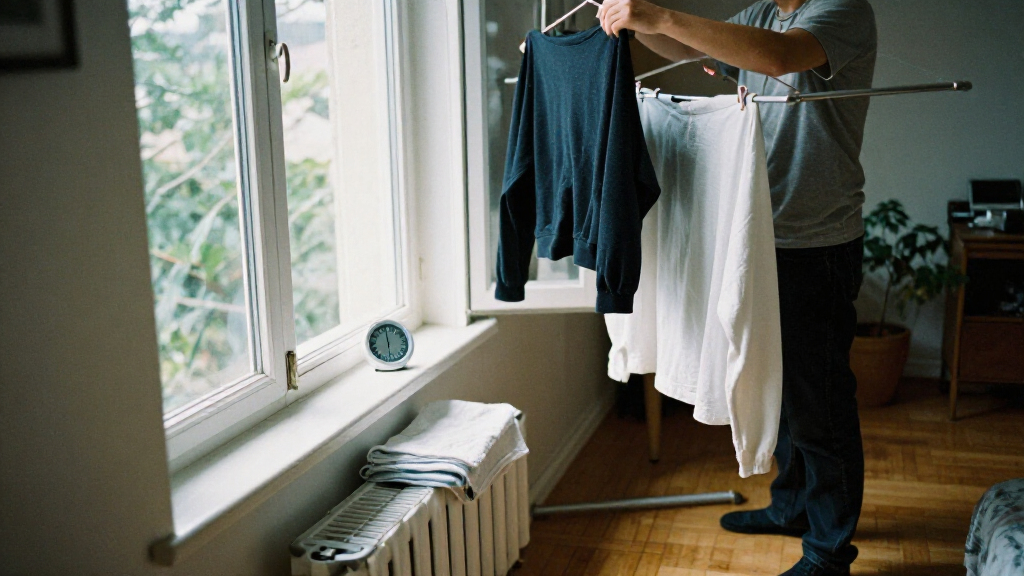
It also advises leaving space between garments rather than filling every part of an airer. The report quotes Lauren Roelofs, a laundry expert at Brabantia, saying that gaps allow air to circulate and help clothes dry more evenly. It recommends spreading sleeves, opening shirts and avoiding folded-over trouser legs; heavier items can be turned during drying to address damp patches.
The remaining suggestions concern equipment and room conditions: use a heated clothes airer if appropriate, pair the rack with a dehumidifier, place it where air can move around it, and ventilate the room. The report says a cover for a heated airer may help retain warmth and, depending on the load and conditions, reduce drying time by a couple of hours. It does not give a controlled test or a general estimate for how much moisture these measures remove.
Reducing Moisture from Indoor Laundry
Wet clothes release water into indoor air as they dry. If moisture builds up and ventilation or moisture removal is limited, it can contribute to condensation and damp conditions. The report’s recommendations address several parts of that process: removing water before clothes are hung, allowing airflow around them, and managing moisture in the room.
These steps may be useful for households without outdoor drying space or a tumble dryer, especially in colder, wetter seasons. A dehumidifier is presented as a way to remove moisture from the air, while a heated airer is intended to assist drying. Neither appliance replaces good placement and ventilation, and the report does not claim that following the list guarantees mould prevention. Persistent condensation or visible mould can have causes beyond laundry and may require a separate assessment.
Products Worth Considering

eufy Security E30 4K Indoor Camera, 2-Pack

Philips Hue Festavia 130-Foot Indoor/Outdoor Smart String Lights, 500 LEDs

Shark Rotator Lift-Away Upright Vacuum with HEPA Filter (NV501)
As an affiliate, we earn on qualifying purchases.
Why Indoor Drying Needs Airflow
The guidance responds to a common seasonal problem: when outdoor drying is difficult, households may rely more heavily on clothes airers. The article describes the underlying issue as water evaporating from wet washing and remaining indoors if it is not dispersed or removed.
Ideal Home includes comments from two industry representatives. Roelofs of Brabantia discusses airflow and rack spacing; Catrin Parry, a buying lead at Lakeland, recommends considering a heated airer and pairing an airer with a dehumidifier. The article also names specific products, but its core advice is about general practices rather than a requirement to buy those models.
“One of the simplest ways to speed things up is to avoid overcrowding your drying rack. Leaving space between garments allows air to circulate, helping clothes dry more evenly.”
— Lauren Roelofs, laundry expert at Brabantia, as quoted by Ideal Home
Limits of the Drying Advice
The source does not specify how much each measure reduces indoor humidity, condensation or mould risk, and it does not describe a controlled comparison of the six tips. Drying times and moisture levels can vary with the room, ventilation, weather, load size and fabric. The article’s estimate that an airer cover may save a couple of hours is explicitly dependent on the load and conditions.
It is also unclear from the report whether any particular combination of steps is sufficient in a home that already has persistent damp, poor ventilation or mould. The recommendations should be read as practical laundry guidance, not a diagnosis or a guarantee that mould will be avoided.
Putting the Six Tips to Work
The report offers no scheduled follow-up or new study. For households applying the advice, the immediate steps are to remove as much water as garment care allows, leave room for air to circulate and choose a spot where the airer is not pressed against a wall. Ventilating the room and, where suitable, using a dehumidifier can help address moisture in the air.
Readers considering heated equipment should compare capacity, running costs and the manufacturer’s instructions for safe use. The report’s broader point is to manage both sides of indoor drying: help clothes dry efficiently and avoid allowing the released moisture to accumulate.
Key Questions
What are the six indoor laundry-drying tips?
Run an extra spin if suitable for the clothes, space items on the airer, consider a heated airer, use a dehumidifier, place the airer where air can circulate and ventilate the room.
Why leave gaps between clothes on a drying rack?
Gaps help air move around garments, which the report says can help clothes dry more evenly. Spread out sleeves and avoid overlapping heavier items where possible.
Does a heated clothes airer remove moisture from the room?
The report says a heated airer helps dry laundry, but does not itself remove the moisture released into the room. It recommends a dehumidifier as a separate option for removing excess moisture from the air.
Will these steps guarantee there is no damp or mould?
No. Ideal Home presents them as practical ways to manage laundry and moisture, not as a guarantee. The report does not quantify their effect, and persistent damp or mould may have other causes.
Source: idealhome.co.uk