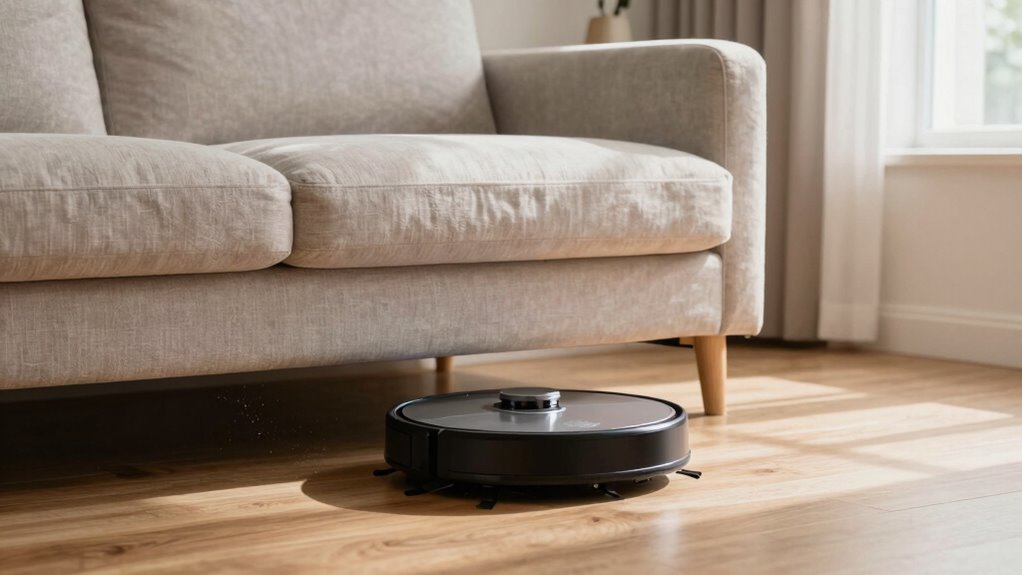
Robot vacuums often skip under low furniture due to insufficient clearance. If their height and any protrusions, like brush housings, exceed the available space, they can’t navigate properly. Uneven surfaces or dark materials may mislead sensors, causing avoidance of certain areas. Ensuring your furniture has at least 95 mm of clearance is essential for optimum performance. Making adjustments to your home can help, and there’s more to uncover about maximizing your vacuum’s efficiency.
Key Takeaways
- Robot vacuums require adequate clearance to access low furniture, typically needing at least 95 mm of free height for effective cleaning.
- Protrusions like brush housings can reduce usable clearance, causing vacuums to skip areas beneath furniture.
- Height-sensing technology may lead to avoidance of spaces if the vacuum detects insufficient clearance due to uneven surfaces or low heights.
- Dark or reflective materials can confuse sensors, resulting in missed spots or skipped cleaning under low furniture.
- Maintaining and cleaning sensors is crucial for accurate height detection, ensuring vacuums effectively navigate complex home environments.

When you’re considering a robot vacuum, understanding its clearance capabilities is essential, especially if you have low furniture. Most mainstream models, like the Eufy S1, stand around 9.6 cm tall, while low-profile options are typically under 3.5 inches. But remember, the actual clearance needed isn’t just about height; it’s also influenced by protrusions like brush housings or bumpers. These can reduce usable clearance considerably, making it vital to check the manufacturer’s recommendations. For instance, Eufy suggests at least 11 cm of clearance for optimal operation, while the Roomba requires around 92 mm.
Understanding a robot vacuum’s clearance is crucial, especially with low furniture; height and protrusions affect usability.
You might find that your vacuum skips certain low areas due to its height-sensing technology. If it detects insufficient clearance, it’ll simply turn away. Uneven surfaces under furniture can also lead to traps, as can dark or reflective materials that confuse the sensors. These factors contribute to your vacuum missing spots that need cleaning, leaving you with dust bunnies lurking beneath your furniture. Additionally, it’s crucial to consider the vacuum’s threshold climbing capabilities when choosing a model, as higher thresholds can also restrict access to lower furniture.
To avoid these issues, measure your furniture clearance before buying a vacuum. If you have a gap less than the robot’s height, it’s smart to go for a low-profile model. For example, the AEG robotic vacuums need at least 95 mm of free height and might not fit under your furniture if it’s too low. If your furniture is just above the recommended clearance, consider using no-go zones in the app to prevent the robot from getting stuck.
You’ll also want to keep an eye on your robot’s sensors. Regularly cleaning them can help maintain accurate height detection and prevent false readings. This is especially important in homes with dark furniture or uneven surfaces, as these factors can lead to avoidance behavior. Investing in a model with advanced navigation technology, like 3D cameras, can also make a difference, allowing the vacuum to better assess low clearances without skipping them.
In practical terms, elevating your furniture slightly, using ramps for thresholds over 50 mm, or even adjusting your cleaning schedule to focus on areas your robot can access will yield better results. By understanding clearance requirements and adjusting your home setup accordingly, you can maximize your robot vacuum’s efficiency and ensure a cleaner living space.
Frequently Asked Questions
Can Robot Vacuums Clean Corners Effectively Under Low Furniture?
Robot vacuums can struggle to clean corners effectively under low furniture. Their height and design often prevent them from accessing tight spaces, leading to missed areas. If you’ve got low-profile furniture, consider a vacuum specifically designed for such spaces. Regular maintenance of sensors and brushes is essential to guarantee they navigate corners smoothly. Testing your vacuum in low areas will help you understand its capabilities and adjust your cleaning strategy accordingly.
How Do I Prevent My Robot Vacuum From Getting Stuck?
To prevent your robot vacuum from getting stuck, start by strategically setting up spaces. Shift shelves, secure cords, and elevate furniture to enhance accessibility. Regularly clean sensors and brushes to maintain peak performance. Utilize virtual barriers and no-go zones to guide your robot away from tricky tight spots. Finally, consider a model designed for low-clearance cleaning, ensuring it can confidently navigate your home’s unique layout without constant concern of getting trapped.
Do All Robot Vacuums Have the Same Clearance Specifications?
No, not all robot vacuums have the same clearance specifications. Some models measure around 4 inches tall, while low-profile versions are typically less than 3.5 inches. It’s essential to check the specific height and design features of the vacuum to determine if it can navigate under your furniture. Consider your home’s layout and the vacuum’s attributes to guarantee effective cleaning in those tight spaces.
What Maintenance Is Required for Under-Furniture Cleaning Efficiency?
To maintain under-furniture cleaning efficiency, regularly check and clean your robot vacuum’s sensors, brushes, and bumper strips. Dust and debris can clog sensors, leading to false detections and missed areas. Keep the dustbin emptied to avoid suction loss, and inspect the wheels for wear or obstruction. Monitor the robot’s performance in low-clearance areas, adjusting furniture or settings as needed to guarantee it can navigate effectively and reach those hard-to-clean spots.
Are Low-Profile Robot Vacuums Less Powerful Than Standard Models?
Yes, low-profile robot vacuums often pack less power than standard models. They typically come with smaller motors, reduced suction, and smaller dustbins. While they might fit under your furniture, they may lack the robust cleaning performance of taller units. You’ll sacrifice some suction for the ability to clean tight spaces. So, if you prioritize cleaning power over convenience, a standard model might serve you better in the long run.
Conclusion
In the world of robot vacuums, low furniture is like a tightrope for a gymnast; it requires precision and the right balance of clearance. Just as a gymnast can’t perform a perfect routine without room to maneuver, your robot vacuum can’t reach every corner under your couch or bed if it lacks the height. Understanding these limitations helps you optimize your cleaning routine, ensuring your little helper doesn’t miss those hidden dust bunnies waiting in the shadows.